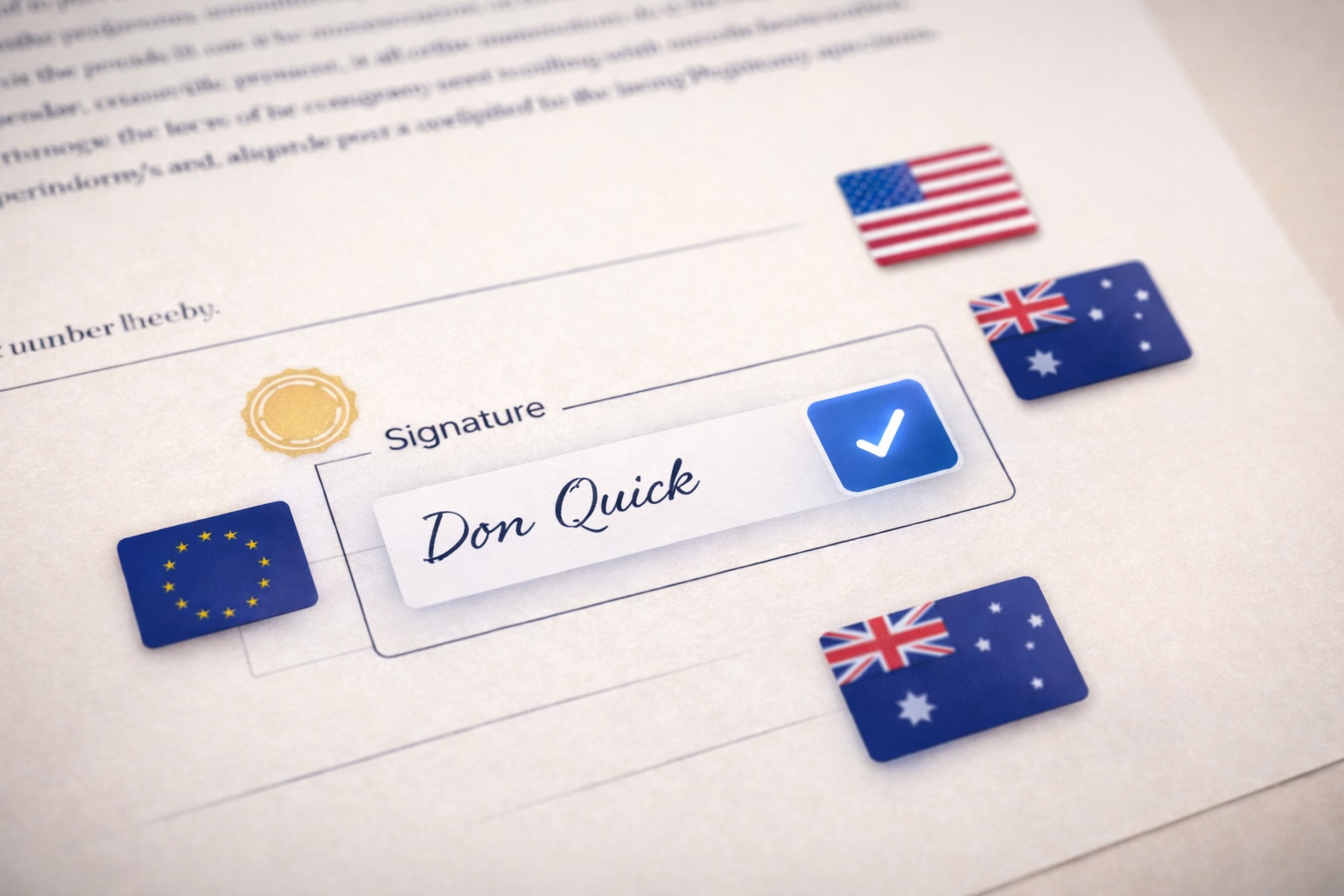
Why the Legal Framework Matters
Electronic signatures are legally binding in every major jurisdiction. That much is settled. But the specific requirements for what makes a signature valid — and what can invalidate one — vary significantly depending on which legal framework applies to your transaction.
For organizations operating across borders, this creates a practical problem. A signing workflow that satisfies US federal law may fall short of EU requirements. A platform that works for domestic contracts may produce signatures that lack enforceability in the Middle East or Australia. And a single missing element — no consent record, no audit trail, a tampered document hash — can turn a binding agreement into an unenforceable one.
Understanding the three primary frameworks is not optional for legal, compliance, and operations leaders. It is the foundation for selecting a signing platform that actually holds up when challenged.
The ESIGN Act: US Federal Baseline
The Electronic Signatures in Global and National Commerce Act (ESIGN) became US federal law in 2000. Its core principle is straightforward: electronic signatures and electronic records carry the same legal weight as their paper equivalents.
ESIGN establishes four requirements for a valid electronic signature:
- Intent to sign — the signer must demonstrate intent to execute the document, just as they would with a wet-ink signature
- Consent to do business electronically — all parties must affirmatively agree to conduct the transaction electronically, and that consent must be documented
- Association of signature with the record — the electronic signature must be connected to the specific document being signed, not floating independently
- Record retention — the signed document must be accurately preserved and remain accessible for the legally required retention period
ESIGN is technology-neutral by design. It does not mandate a specific signing method, encryption standard, or identity verification process. This flexibility gives platforms latitude in implementation, but it also means that the burden of proving validity falls on the quality of your process and your audit trail.
One critical detail: ESIGN requires that consumers receive a clear disclosure about electronic signatures before consenting, and that they have the option to withdraw consent. If your platform skips this disclosure step, signatures obtained through it may be challenged.
UETA: The State-Level Complement
The Uniform Electronic Transactions Act (UETA) predates ESIGN by one year (1999) and operates at the state level. It has been adopted by 49 US states. New York has not adopted UETA but has its own Electronic Signatures and Records Act (ESRA), which covers similar ground with some procedural differences.
UETA complements ESIGN by adding two important concepts:
- Attributability — an electronic signature must be attributable to the person who signed. This means the system must capture enough identifying information (IP address, email authentication, device metadata, timestamps) to demonstrate who executed the signature.
- Effect of change — if a signed electronic record is altered after signing, the change must be detectable. Records that have been tampered with lose their legal effect.
In practice, UETA and ESIGN work together. ESIGN provides the federal baseline that preempts conflicting state laws, while UETA provides the state-level procedural framework. For most US transactions, compliance with both is straightforward if your platform implements proper identity attribution and document integrity controls.
The key takeaway: UETA's attributability requirement means anonymous or weakly authenticated signatures carry legal risk. If you cannot prove who signed, the signature's validity is questionable regardless of what the document says.
eIDAS: The EU's Three-Tier System
The European Union's electronic Identification, Authentication and Trust Services regulation (eIDAS) takes a fundamentally different approach from US law. Rather than treating all electronic signatures as legally equivalent, eIDAS defines three tiers with increasing levels of legal presumption:
Simple Electronic Signature (SES) — the broadest category. Any electronic indication of intent to sign qualifies: a typed name, a click-to-accept button, a scanned signature image. SES is admissible as evidence but carries no special legal presumption. The burden of proving authenticity falls on the party relying on the signature.
Advanced Electronic Signature (AES) — requires that the signature is uniquely linked to the signer, capable of identifying the signer, created using data under the signer's sole control, and linked to the signed data such that any subsequent change is detectable. AES provides stronger evidentiary weight than SES but still does not carry automatic legal presumption.
Qualified Electronic Signature (QES) — the highest tier. A QES is an advanced electronic signature created using a qualified electronic signature creation device (a hardware token or smart card) and backed by a qualified certificate issued by an EU-accredited trust service provider. QES is the only electronic signature type that carries the same legal presumption as a handwritten signature across all EU member states.
The practical implication: for high-value transactions, regulated industries, and cross-border agreements within the EU, QES provides the strongest legal standing. For routine business documents, AES typically suffices. SES works for low-risk transactions where the likelihood of dispute is minimal.
eIDAS also mandates cross-border recognition. A qualified electronic signature issued in Germany must be accepted in France, Italy, or any other EU member state. This interoperability is a significant advantage for organizations operating across European markets.
Australia and the Middle East
Australia's Electronic Transactions Act 1999 (ETA) follows a similar model to the US ESIGN Act. Electronic signatures are generally admissible and enforceable, provided the method used identifies the signer, indicates their approval of the information, and is reliable and appropriate for the purpose.
However, the ETA includes notable exclusions. Certain document categories — including citizenship and migration documents, real property transactions in some states, court documents, and powers of attorney — may require wet-ink signatures depending on the state or territory. Organizations operating in Australia need to verify whether their specific document type falls within these carve-outs.
Saudi Arabia's Electronic Transactions Law (ETL) governs electronic signatures in the Kingdom and is particularly relevant for organizations with Middle East operations. The ETL recognizes electronic signatures and electronic records as legally valid, with specific provisions for government transactions and regulated industries. Compliance with Saudi ETL requires platforms to support Arabic-language documents, local data residency considerations, and authentication methods aligned with Saudi regulatory expectations.
What Makes a Signature Legally Valid — And What Breaks It
Across all frameworks, four elements consistently determine whether an electronic signature will hold up under legal scrutiny:
| Element | What It Requires | What Breaks It |
|---|---|---|
| Intent to sign | Clear affirmative action by the signer | Ambiguous UI where signing could be accidental |
| Consent to electronic process | Documented agreement to transact electronically | No consent record, or consent buried in unrelated terms |
| Association with the document | Signature cryptographically or procedurally linked to specific content | Signature detached from document, or applied to wrong version |
| Record integrity | Document provably unaltered since signing | No tamper-evident sealing, or hash mismatch after modification |
The absence of any one of these elements gives opposing counsel an attack vector. The most common failures in practice are missing consent records (the platform never captured explicit agreement to sign electronically) and broken integrity chains (the document was modified after signing, or the platform cannot prove it was not).
What a Compliant Platform Needs
Meeting the requirements of ESIGN, UETA, eIDAS, and equivalent international frameworks is not about checking a box. It requires specific technical capabilities embedded into the signing workflow:
- Certificate Authority (CA) issued digital certificates — signatures backed by certificates from recognized CAs (not self-signed) establish cryptographic proof of signer identity and document integrity
- SHA-256 tamper-evident document sealing — every signed document must be sealed with a cryptographic hash that detects any modification, however minor, after execution
- Comprehensive audit trail — per-document logs capturing every action: when the document was created, sent, opened, viewed, signed, and by whom, with IP addresses, device identifiers, and timestamps
- Multi-factor signer authentication — identity verification options including SMS OTP, email OTP, knowledge-based authentication, and government ID verification to satisfy attributability requirements
- Sequential and parallel signing — support for complex signing orders where some parties must sign before others, while allowing parallel execution where appropriate
- Consent capture and disclosure — automated delivery of electronic signature disclosures with documented acceptance before the signing process begins
- Long-term document preservation — signed documents stored in formats that remain accessible and verifiable beyond the original signing session
Platforms that lack any of these capabilities create compliance gaps that may not surface until a signature is challenged — which is precisely the worst time to discover them.
How DocQ Handles Multi-Framework Compliance
DocQ's eSign module is engineered for organizations that operate across jurisdictions and cannot afford to maintain separate signing workflows for different regulatory regimes.
Every signature executed through DocQ is backed by CA-issued digital certificates and sealed with SHA-256 cryptographic hashing. The moment a document is signed, it becomes tamper-evident — any subsequent modification breaks the hash and is immediately detectable. This satisfies the record integrity requirements of ESIGN, UETA, and eIDAS simultaneously.
For signer identity verification, DocQ supports layered authentication: SMS OTP, email OTP, knowledge-based authentication, and document-based ID verification. Organizations can configure authentication strength per document type — routine internal approvals might require email verification, while high-value contracts trigger multi-factor authentication with government ID checks.
DocQ's audit trail captures every event in the document lifecycle with granular detail: document creation, delivery, each viewing session, signature execution, and final completion. Each event is timestamped and attributed to a specific identity with supporting metadata. This audit trail is attached to the document permanently and is available for instant retrieval during compliance reviews or legal proceedings.
For multi-party transactions, DocQ supports both sequential signing (where signers execute in a defined order) and parallel signing (where multiple parties can sign simultaneously). Signing workflows can span any combination of these patterns, accommodating complex approval chains common in enterprise procurement, real estate, and financial services.
DocQ also maintains compliance with Saudi Arabia's Electronic Transactions Law, supporting organizations with Middle East operations that require adherence to regional electronic signature regulations alongside ESIGN and eIDAS.
The practical result: a single signing workflow that produces signatures enforceable under US, EU, Australian, and Middle Eastern legal frameworks — without requiring legal or compliance teams to manage framework-specific processes for each jurisdiction.